Other books by Dave Whitaker:

Showing posts with label Holy Grail. Show all posts

Wednesday, April 3, 2013

Important Arthurian Works: Culhwch and Olwen

Evidence has suggested that this Welsh prose tale dates to the 11th century, which could make it the earliest Arthurian tale. The work has been preserved in the manuscript, Red Book of Hergest, and in partial form in the White Book of Rhydderech. It has also been included as part of Lady Charlotte Guest’s collection of translations of eleven medieval Welsh prose stories, The Mabinogion. The story has been cited as an influence on J.R.R. Tolkien’s The Silmarillion.

Click to order.
The story focuses on Culhwch, the son of a king, and Olwen, the daughter of a giant named Ysbaddaden. Culhwch turns to his famous cousin, Arthur, for assistance in winning the beautiful Olwen away from her father. Ysbaddaden has given Culhwch a series of seemingly impossible tasks to complete before he will grant his daughter’s hand in marriage. Some of the challenges and quests with which Culhwch is tasked carved a blueprint for some of the more famous Arthurian legends, including the search for the Holy Grail.
Resources:

Sunday, March 24, 2013

Important Arthurian Works: Chrétien de Troyes

In the late 12th century, Frenchman Chrétien de Troyes was a poet in the court of Marie, countess of Champagne, suggesting he may have been a court poet. He wrote five major poems in eight-syllable rhyming couplets:
  • Érec et Énide (c. 1165-1170)
  • Cligès (c. 1176)
  • Yvain, the Knight of the Lion (c. 1171-1181)
  • Lancelot, le Chevalier de la Charrette (Lancelot, the King of the Cart) (c. 1177-1181)
  • Perceval, le Conte du Graal (Perceval, the Story of the Grail) (c. 1181-1190)
The first four were finished, but Perceval was not. He finished only 9000 lines, but 54,000 lines were added by four other writers. These works, especially the latter two, are significant for introducing the character of Lancelot and the quest for the Holy Grail to Arthurian legend. Those tales were expanded in the Vulgate Cycle in the first half of the next century.
Resources:

Saturday, March 23, 2013

Important Arthurian Works: The Vulgate Cycle

The Vulgate Cycle consisted of five French prose volumes written in the early 13th century (c. 1225-1240) by an unknown author or authors, although they are sometimes attributed to Walter Map, a clerk for King Henry II. There is also speculation that one person may have outlined the cycles but several authors (possibly the Cistercian monks) wrote them.

The Vulgate Cycle, also known as the Lancelot-Grail Cycle, makes Lancelot and the story of the Holy Grail the main focuses. The stories expanded on ideas introduced by French poet Chrétien de Troyes and may have derived from other sources as well, including Geoffrey of Monmouth. They are a major influence on Thomas Malory’s Le Morte d’Arthur.

book cover from The History of the Holy Grail, image from Amazon.com

The five volumes are:
  • Estoire du Graal (History of the Grail), c. 1240. This is a reworking of French poet Robert de Boron’s Joseph of Arimathea (c. 1200), which keys in on the story of Joseph of Arimathea taking the Holy Grail to Britain.
  • Estoire de Merlin (History of Merlin), aka Vulgate Merlin or Prose Merlin, c. 1240. This is a prose adaptation of Boron’s Merlin. It tells stories of Arthur’s early years, such as the circumstances of his birth, how he was raised by Sir Ector, educated by Merlin, and how he becomes king via the sword in the stone. The book ends with the death of Merlin at the hands of Nimue, the Lady of the Lake.
  • Lancelot Propre (Lancelot Proper), c. 1225. The story focuses on Lancelot instead of King Arthur. Among the stories are the knight’s birth, how he was raised by the Lady of the Lake, how his befriending of the giant Galehaut, his rescue of Guinevere from abduction, and the birth of Lancelot’s son, Galahad.
  • Queste del Saint Graal (Quest of the Holy Grail), c. 1230. Sir Galahad is introduced as the one pure knight who can sit at the Siege Perilous, the designated seat at King Arthur’s Round Table for the one who will lead the Grail quest.
  • La Mort de roi Artu (The Death of King Arthur), c. 1235. This volume details the adultery of Lancelot and Guinevere and how Mordred (introduced here as Arthur’s son for the first time) destroyed Camelot and killed Arthur.

Following the five volumes of the Vulgate Cycle were a collection which is known as the Post-Vulgate Cycle. Written between 1230-1250, these were essentially a reworking of the Vulgate Cycle with parts omitted (much of the love affair between Lancelot and Guinevere), other parts emphasized more (Holy Grail), and some additional stories added (Tristan).


Resources:

Sunday, March 17, 2013

Legend of the Holy Grail

The story of the Holy Grail is one of the most prominent stories which features into Arthurian legend. Like many of the tales associated with King Arthur, it has a historical basis, but over generations of retelling the story, it has taken on different twists.

Historically, the grail is considered to be some sort of container - generally a goblet - although this varies. There may be a basis of a cauldron with special powers in Celtic myth. The grail also portrayed as the cup from which Christ drank at the Last Supper and/or also may have been the chalice used to collect his blood after his crucifixion.

Joseph of Arimathea - who has been theorized to be Christ's great uncle - is, depending on the account, thought to be the person who brought the grail to England. It has specifically been tied to Glastonbury, which is generally considered the site of Avalon in Arthurian legend. It also considered to be the site of the first Christian church in England, built by Joseph of Arimathea.

image from messiah.edu

Chrétien de Troyes introduced the Holy Grail to Arthurian legend via his unfinished work, Le Conte du Graal (c. 1185), also known as Perceval le Gallois. The knight Perceval (later called Sir Galahad) encounters the Fisher King, who is stuck in limbo between life and death. Perceval is tasked with the quest of retrieving the Holy Grail, which will relieve the Fisher King of his suffering.

French poet Robert de Boron also took up the tale with three books, of which only Joseph d' Arimathea (c. 1200), has survived in tact. It has been retold as one of the Vulgate cycles in Estoire de Saint Graal (c. 1240). Fragments of the second, Merlin, exist and the third, Perceval, is lost. Didot Perceval (c. 1205) is considered a version of the latter, written anonymously in prose. In Joseph d' Arimathea, Boron extends the story of Perceval by introducing the idea that he is the pure knight who can sit at Siege Perilous, a special seat at the Round Table.

image from pantheon.org

In the context of the Otter and Arthur stories, the grail is shaping up to be the centerpiece of a possible third book, Otter and Arthur and the Holy Grail. While there is only a rough sketch at this time, the basic premise of the story may be that it is Sir Gawain who seeks the Holy Grail, an idea first put forth in Heinrich von dem Türlin's poem Diu Crône (c. 1220), which in English means "The Crown."


Resources:
  • Robert de Boron (c. 1200). Joseph d' Arimathea
  • Robert de Boron (c. 1200). Merlin
  • Robert de Boron (c. 1200). Perceval
  • Chrétien de Troyes (c. 1185). Le Conte du Graal or Perceval le Gallois
  • Didot Perceval (c. 1205)
  • Justin E. Griffin (2001). The Holy Grail: The Legend, the History, the Evidence. McFarland & Company, Inc.: Jefferson, NC, and London.
  • TimelessMyths.com: Grail Legend: Perceval's Tradition
  • Heinrich von dem Türlin (c. 1220). Diu Crône
  • Vulgate Cycle Estoire de Saint Graal (c. 1240)
  • Wikipedia.org: The Holy Grail

Sunday, February 10, 2013

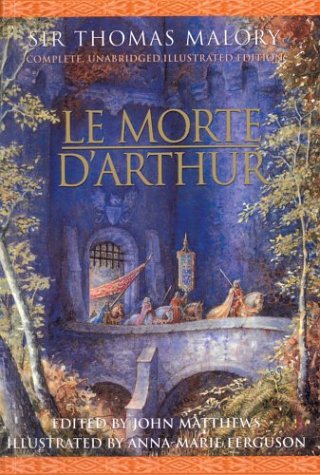
Important Arthurian Works: Le Morte d'Arthur

Sir Thomas Malory’s Le Morte d’Arthur was one of the earliest printed books in England and is probably the best-known work of English-language Arthurian literature today. It was originally written as eight books and then published as 21 books by William Caxton in 1485.

Malory likely started work on the project in the early 1450s while he was in prison and completed it by 1470. His aim was to create a comprehensive and authoritative collection of Arthurian stories. To that end, he largely translated the French Vulgate Cycle and compiled them with other Middle English sources.

The original eight books were:
  • Book I: From the Marriage of King Uther unto King Arthur that Reigned After Him and Did Many Battles (Caxton I–IV)
  • Book II: The Noble Tale Between King Arthur and Lucius the Emperor of Rome (Caxton V)
  • Book III: The Noble Tale of Sir Launcelot Du Lac (Caxton VI)
  • Book IV: The Tale of Sir Gareth of Orkney (Caxton VII)
  • Book V: The First and the Second Book of Sir Tristrams de Lione (Caxton VIII–XII)
  • Book VI: The Noble Tale of the Sangreal (Caxton XIII–XVII)
  • Book VII: Sir Lancelot and Queen Guinevere (Caxton XVIII–XIX)
  • Book VIII: The Death of Arthur (Caxton XX–XXI)

Resources: