Other books by Dave Whitaker:

Showing posts with label Stonehenge. Show all posts

Wednesday, October 9, 2013

Otter and Arthur sequel coming soon!

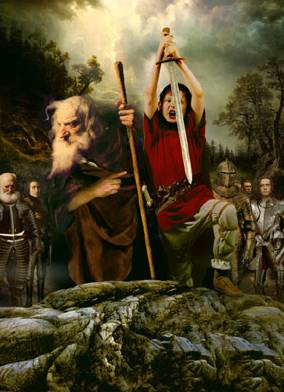
image from Merlin BBC series as posted on wikia.com

The sequel to Otter and Arthur and the Sword in the Stone is coming soon! Here's a sample from Otter and Arthur and the Round Table:

Chapter 8: Stonehenge (an excerpt)

Once we were a safe distance from Morgan’s castle, Ferdinand landed so we could reposition ourselves on his back. “That was incredible!” Dindra whooped. “Do you two live like this all the time?”

Ferdinand and I smiled at each other. “To be honest,” I confessed, “it has been awhile since we’ve had any big adventures.”

Dindra looked bewildered. “King Arthur? Camelot? Merlin? Flying on a falcon’s back?” She patted Ferdinand. “How could life ever be boring?”

“Well, it just got interesting again recently,” I answered over my shoulder. Dindra, who had her arms wrapped around my waist, squeezed a little tighter and smiled.

* * *

We arrived at Stonehenge just as the sun was rising. “That,” said Dindra breathlessly, “is the most amazing sight I’ve ever seen.”

“No people – and few animals – get a bird’s eye view of this,” Ferdinand replied. Dindra and I laughed.

The stones were as tall as four men standing on each other’s shoulders. An outer circle wrapped around five sets of larger stones. A vast empty field surrounded the massive monument. “How do you think humans moved those huge rocks?” Dindra wondered aloud.

I shook my head in amazement. “I don’t know. Just think, though. The same creatures who made this also invented war.”

“Sometimes it is hard to believe people think they’re smarter than us,” Ferdinand added.

He floated down and landed on one of the larger rocks in the center. I smiled upon seeing the two people who gave me hope for humanity: the sleeping figures of Arthur and Merlin. They had set up camp in the middle of the stone circle. A few glowing embers lingered from a campfire and two sleeping horses were tied to a smaller rock nearby.

As I pondered some clever way to wake Arthur, Merlin sat up and looked straight at us and smiled. He seemed pleased, but unsurprised to see us.

Ferdinand flapped down and Merlin patted him on the head. “Good morning,” the wizard said. “You two must have had quite the adventures.” Then he noticed Dindra. “Make that three.”

“Who are you talking to, Merlin?” Arthur sat up and rubbed his eyes. “Otter!”

I rushed to the king and gave him our traditional thumb-hug greeting. “What happened?” he asked. “What took you so long to get here? Are you okay?” Before I could answer, he raised an eyebrow and said, “I see you’ve got a friend with you.”

I introduced Dindra and told Arthur and Merlin how she saved my life. However, I was focused on the urgency of our situation.

“We have to get back!” I exclaimed. “Lot’s going to attack Dragon’s Head and take over Camelot!”

Merlin smiled, looking unalarmed. “Sometimes when the perceived need is to hurry the best solution is to slow down.”

I was annoyed with Merlin for staying so calm. He’s probably had a vision of what’s going to happen, I thought.

He offered no explanation. Instead he gazed up at the orange hue slowly conquering the grey nighttime sky. “I believe I shall go for a ride. I’d like to enjoy the onset of this glorious day. Arthur, perhaps you can share your new idea with Otter.”

Arthur stirred the coals of the campfire. Dindra and I settled down on a nearby rock.

“Pretty amazing, isn’t it?” Arthur asked as he took a seat and gazed up at the stones surrounding us. “I bet you’re wondering why Stonehenge was built.” Dindra and I shook our heads and Arthur continued. “Merlin told me people think it is a place for healing or studying the stars.” He paused and got a serious look on his face. “Otter, this is where my father is buried.”

”Is that why Merlin brought you here?” I asked.

Arthur nodded. “My father saw Stonehenge as a symbol of power and strength. That’s the kind of ruler he wanted to be. However, here’s my idea.” Arthur pulled his pack toward him. “Dindra, you’ll be interested to know it was Otter who made me think of this.” He pulled a loaf of bread out.

I scratched my head. “Bread? That was my idea? How’s that going to make you a better leader?”

“No,” Arthur laughed. “I thought you two might be hungry.” He tore off two chunks and handed them to us. “This was Otter’s idea,” he said, retrieving a piece of parchment. He laid it down and smoothed it out. It was a sketch of Stonehenge.

“Stonehenge was my idea?”

“Well, Stonehenge looks like a giant table to me. It reminded me of your first visit to Dragon’s Tail. Your uncle called a meeting of all the mouse village residents at a round stage. It’s how I’m going to lead Britain.”

“From a round stage in a mouse village?” I munched on my bread and stared at Arthur.

“No,” he chuckled. He waved his arm at the huge rocks surrounding us. “One person didn’t do this alone. If I want to unite Britain, I can’t do that alone. I’ll invite knights and leaders to Camelot to work together. We’ll sit at a round table. At a rectangular table, someone sits at the head and automatically seems more important. At a round table, everyone is equal.”

Hmm… can’t do it alone. An idea was brewing about how I could get Excalibur back.

Friday, December 28, 2012

The Legend of Stonehenge

image from commons.wikipedia.org

Stonehenge, the massive rock-circle monument on Salisbury Plain in the south of England, has been a source of intrigue for centuries. Eighty-five stones reach higher than 20 feet and some weighing more than 40 tons. Some appear to have been hauled from as much as 240 miles away. The structure is estimated to date back to as far as 3100 B.C., a time pre-dating writing, the use of cranes, and even the invention of the wheel.

Almost as puzzling as how it was created is why it was created. Among the theories are that it was created as a burial ground, served as a sort of farmer’s almanac, or was constructed as an observatory for tracking the movements of the stars and planets.

The astonishing structure and its mysteries have, not surprisingly, found their way into Arthurian legend. When Arthur’s father, Uther Pendragon, took the throne he wanted to build a monument to memorialize his brother, Aurelius Ambrosius, and those who had fallen in fighting off the Saxons. He enlisted Merlin to travel to Ireland and magically move the giant stones, known as the Giant’s Dance, to Wiltshire, England, where Stonehenge now stands. See “The Legend of the Red and White Dragons” and “Character Study: Merlin” for more details.

In Otter and Arthur and the Round Table, Stonehenge is pivotal to Arthur’s understanding of his heritage and his future. Merlin takes the young, doubting king to visit it. Where Uther Pendragon saw the massive structure as a symbol of power and strength, Arthur focuses on the circular structure as symbolic of unity and equality. His idea of building his kingdom around those principles – and an actual Round Table to represent those ideals – is born.


Resources:

Tuesday, October 16, 2012

Character Study: Merlin

Geoffrey of Monmouth introduced the character of Merlin (known in Welsh as Myrddin) to Arthurian legend. He is typically portrayed as a sorcerer with the power to see the future. Some accounts, such as the Vulgate Cycle, suggest these are the result of Merlin's birth to a demon and a mortal woman. He is typically seen as King Arthur's protector, mentor, and the very reason for Arthur's legendary status. For example, it is Merlin who is typically portrayed as the one who thrust the sword in the stone which Arthur later pulls out to secure his place as the rightful heir to the throne.

In most tales, Merlin orchestrates Arthur's birth by using magic to let Uther Pendragon take the form of Gorlois, the Duke of Cornwall. Uther then sleeps with Lady Igraine and Arthur is conceived.

image from califa.us

Geoffrey adapts a story from Nennius in which Merlin is seen as a child telling the King Vortigern that a castle's walls collapse because of two fighting dragons in an underground pool (see more on that legend here). Geoffrey also tells a story of Merlin being responsible for the creation of Stonehenge.

The Vulgate Cycle says Merlin's death comes at the hands of the Lady of the Lake, also known as Nimue. Merlin falls in love with her and teachers her magic. She then turns on him and traps him for eternity in a crystal cave.

Merlin has been a model for other wizards in history, such as J.R.R. Tolkien’s Gandalf in The Hobbit and The Lord of the Rings, and Professor Dumbledore in J.K. Rowling’s Harry Potter series.

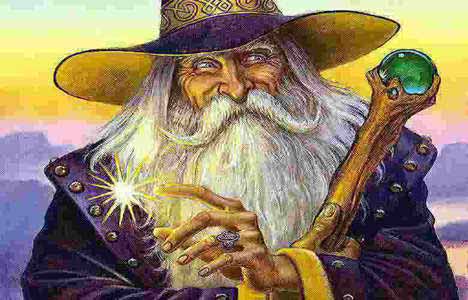
image from crystalinks.com

In the Otter and Arthur stories, Merlin is seen in a positive light as Arthur's tutor. The wizard does see the future and orchestrates events to ensure Arthur’s destiny, but is also ruled by a code of conduct which disallows him to alter what is meant to be - including his imprisonment for eternity at the hands of Morgan. See her character study here.

Otter, the mouse, who lives in Merlin’s cottage and observes the tutoring of the young Arthur, becomes a sort-of secondary wizard. There is an implication that Merlin has gifted Otter with powers that will allow the mouse to change the supposedly pre-determined downfall of Arthur and Camelot even after the wizard is gone. At the time of this writing, the intention is to have Merlin trapped in a cave by Morgan's evil doing at the conclusion of Otter and Arthur and the Round Table. While she is never romantically linked to Merlin, she embodies traits of Nimue in that it will be revealed that Morgan knows magic because the wizard taught her when she was a young child. The Lady of the Lake is treated as a completely separate character who is more powerful than Merlin, but is good.


Resources:
  • Ronan Coghlan (1993). The Illustrated Encyclopaedia of Arthurian Legends Barnes & Noble Books.
  • Robert de Boron Merlin (c. 1200)
  • Geoffrey of Monmouth Historia Regum Britanniae (c. 1136)
  • Justin E. Griffin (2001). The Holy Grail: The Legend, the History, the Evidence. McFarland & Company, Inc.: Jefferson, NC, and London.
  • Sir Thomas Malory Le Morte d'Arthur (1485)
  • Nennius Historia Brittonum (c. 828)
  • Vulgate Cycle: The Estoire de Merlin (c. 1230-1240)
  • Wikipedia.org entry: Merlin