Other books by Dave Whitaker:

Showing posts with label King Arthur. Show all posts

Thursday, March 5, 2020

Character Study: Guinevere

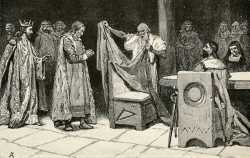
Guinevere (also Gwenhwyfar, Gwenivar, Guenevere or Guenever) is the the wife of King Arthur. She was first introduced to Arthurian legend by Geoffrey of Monmouth in Historia Regum Britanniae. In most Arthurian legend, Arthur and Guinevere never have any children.

The 12th century poem Lancelot, the Knight of the Cart by Chrétien de Troyes, introduced the story in which Guinevere falls for Lancelot, Arthur's supreme knight and best friend. It became canon, most notably in Sir Thomas Malory's Le Morte d'Arthur. The love triangle story was the focus of the 1960 Broadway musical Camelot.

image from The Grandma Logbook

She is the daughter of King Leodegrance in French chivalric romances and later works based on them, most notably Le Morte d'Arthur. Her father served Arthur's father, Uther Pendragon. It is a common part of Arthurian legend that King Leodegrance gives Arthur the famous round table as a wedding present.

In the Otter and Arthur series, Guinevere is introduced briefly in the first book, Otter and Arthur and the Sword in the Stone, and emerges as a strong female character in the second book, Otter and Arthur and the Round Table.


Resources:

Sunday, December 1, 2013

Book: Otter and Arthur and the Round Table

The adventures of King Arthur and his best friend - a mouse nicknamed Otter - continue in this sequel to Otter and Arthur and the Sword in the Stone. Arthur’s sword, Excalibur, is stolen, and Otter must get it back. His journey involves a visit to Stonehenge, a confrontation with the evil sorceress Morgan, falling in love, and magically turning a pack of mice into a flock of invisible swallows. Otter also inspires Arthur’s vision of a new Britain, one ruled by peaceful discussions at a Round Table instead of with swords on the battlefield. However, it will never happen unless Otter can save Camelot from an impending dragon attack. 178 pages. Catalog number: RTBK1013; Price: $12.00

You can buy signed copies directly from me by clicking on the button below. Copies are $12.00 each with NO postage & handling charges or taxes.

The book is also available from Amazon, but is priced at $12.95 and will still having postage & handling and taxes added to the price.


Sunday, July 21, 2013

Important Arthurian Works: J.R.R. Tolkien’s The Fall of Arthur

The Fall of Arthur is an unfinished poem by J.R.R. Tolkien which was written in an Old English alliterative style. Think Beowulf. The poem comprises about only about a fourth of the book, which is mostly an in-depth analysis of the work, and the works which inspired it, as dissected by Tolkien’s son, Christopher. This is a book for fanatics, be they fanatics of anything Tolkien wrote and/or or anything related to the history of Arthurian literature.

Evidence suggests the poem was abandoned in 1937, the year The Hobbit was published. However, in a letter as late as 1955, he talked of his hope of finishing it someday, but alas, that time never came. Christopher Tolkien shows how his father’s work linked to Thomas Malory’s famous Le Morte d’Arthur, the alliterative Morte Arthure, and the French Mort Artu. Christopher also shows how this work related to Tolkien’s pre-Hobbit work, The Silmarillion.

As for the abandoned story and its influences, the primary concern here is the demise of King Arthur. As Arthur and Sir Gawain fight oversees, Arthur’s nephew, Mordred, swoops in and takes over Camelot. The kingdom is further undone by the affair between Arthur’s wife, Guinevere, and his best knight, Lancelot.

The poem, the manuscript notes, and Christopher Tolkien’s comments also reveal the intent of the poem to dissect how the ever-loyal Gawain confronted Lancelot and how Mordred and Arthur’s battle at Camlaan would lead the latter to Avalon to recover from mortal wounds.


Resources:

Tuesday, April 23, 2013

Upcoming Book Signing: May 18

Event: Author Dave Whitaker will be signing copies of Otter and Arthur and the Sword in the Stone.

Date: May 18, 2013
Time: 12:00 pm to 2:00 pm
Place: Shawnee Books & Toys
Address: 7311 Quivira Rd, Shawnee, Kansas 66216

You can sign up for the event on Facebook at Book Signing - Dave Whitaker - Otter and Arthur.


Wednesday, April 3, 2013

Important Arthurian Works: Culhwch and Olwen

Evidence has suggested that this Welsh prose tale dates to the 11th century, which could make it the earliest Arthurian tale. The work has been preserved in the manuscript, Red Book of Hergest, and in partial form in the White Book of Rhydderech. It has also been included as part of Lady Charlotte Guest’s collection of translations of eleven medieval Welsh prose stories, The Mabinogion. The story has been cited as an influence on J.R.R. Tolkien’s The Silmarillion.

Click to order.
The story focuses on Culhwch, the son of a king, and Olwen, the daughter of a giant named Ysbaddaden. Culhwch turns to his famous cousin, Arthur, for assistance in winning the beautiful Olwen away from her father. Ysbaddaden has given Culhwch a series of seemingly impossible tasks to complete before he will grant his daughter’s hand in marriage. Some of the challenges and quests with which Culhwch is tasked carved a blueprint for some of the more famous Arthurian legends, including the search for the Holy Grail.
Resources:

Sunday, March 24, 2013

Important Arthurian Works: Chrétien de Troyes

In the late 12th century, Frenchman Chrétien de Troyes was a poet in the court of Marie, countess of Champagne, suggesting he may have been a court poet. He wrote five major poems in eight-syllable rhyming couplets:
  • Érec et Énide (c. 1165-1170)
  • Cligès (c. 1176)
  • Yvain, the Knight of the Lion (c. 1171-1181)
  • Lancelot, le Chevalier de la Charrette (Lancelot, the King of the Cart) (c. 1177-1181)
  • Perceval, le Conte du Graal (Perceval, the Story of the Grail) (c. 1181-1190)
The first four were finished, but Perceval was not. He finished only 9000 lines, but 54,000 lines were added by four other writers. These works, especially the latter two, are significant for introducing the character of Lancelot and the quest for the Holy Grail to Arthurian legend. Those tales were expanded in the Vulgate Cycle in the first half of the next century.
Resources:

Saturday, March 23, 2013

Important Arthurian Works: The Vulgate Cycle

The Vulgate Cycle consisted of five French prose volumes written in the early 13th century (c. 1225-1240) by an unknown author or authors, although they are sometimes attributed to Walter Map, a clerk for King Henry II. There is also speculation that one person may have outlined the cycles but several authors (possibly the Cistercian monks) wrote them.

The Vulgate Cycle, also known as the Lancelot-Grail Cycle, makes Lancelot and the story of the Holy Grail the main focuses. The stories expanded on ideas introduced by French poet Chrétien de Troyes and may have derived from other sources as well, including Geoffrey of Monmouth. They are a major influence on Thomas Malory’s Le Morte d’Arthur.

book cover from The History of the Holy Grail, image from Amazon.com

The five volumes are:
  • Estoire du Graal (History of the Grail), c. 1240. This is a reworking of French poet Robert de Boron’s Joseph of Arimathea (c. 1200), which keys in on the story of Joseph of Arimathea taking the Holy Grail to Britain.
  • Estoire de Merlin (History of Merlin), aka Vulgate Merlin or Prose Merlin, c. 1240. This is a prose adaptation of Boron’s Merlin. It tells stories of Arthur’s early years, such as the circumstances of his birth, how he was raised by Sir Ector, educated by Merlin, and how he becomes king via the sword in the stone. The book ends with the death of Merlin at the hands of Nimue, the Lady of the Lake.
  • Lancelot Propre (Lancelot Proper), c. 1225. The story focuses on Lancelot instead of King Arthur. Among the stories are the knight’s birth, how he was raised by the Lady of the Lake, how his befriending of the giant Galehaut, his rescue of Guinevere from abduction, and the birth of Lancelot’s son, Galahad.
  • Queste del Saint Graal (Quest of the Holy Grail), c. 1230. Sir Galahad is introduced as the one pure knight who can sit at the Siege Perilous, the designated seat at King Arthur’s Round Table for the one who will lead the Grail quest.
  • La Mort de roi Artu (The Death of King Arthur), c. 1235. This volume details the adultery of Lancelot and Guinevere and how Mordred (introduced here as Arthur’s son for the first time) destroyed Camelot and killed Arthur.

Following the five volumes of the Vulgate Cycle were a collection which is known as the Post-Vulgate Cycle. Written between 1230-1250, these were essentially a reworking of the Vulgate Cycle with parts omitted (much of the love affair between Lancelot and Guinevere), other parts emphasized more (Holy Grail), and some additional stories added (Tristan).


Resources:

Sunday, March 17, 2013

Legend of the Holy Grail

The story of the Holy Grail is one of the most prominent stories which features into Arthurian legend. Like many of the tales associated with King Arthur, it has a historical basis, but over generations of retelling the story, it has taken on different twists.

Historically, the grail is considered to be some sort of container - generally a goblet - although this varies. There may be a basis of a cauldron with special powers in Celtic myth. The grail also portrayed as the cup from which Christ drank at the Last Supper and/or also may have been the chalice used to collect his blood after his crucifixion.

Joseph of Arimathea - who has been theorized to be Christ's great uncle - is, depending on the account, thought to be the person who brought the grail to England. It has specifically been tied to Glastonbury, which is generally considered the site of Avalon in Arthurian legend. It also considered to be the site of the first Christian church in England, built by Joseph of Arimathea.

image from messiah.edu

Chrétien de Troyes introduced the Holy Grail to Arthurian legend via his unfinished work, Le Conte du Graal (c. 1185), also known as Perceval le Gallois. The knight Perceval (later called Sir Galahad) encounters the Fisher King, who is stuck in limbo between life and death. Perceval is tasked with the quest of retrieving the Holy Grail, which will relieve the Fisher King of his suffering.

French poet Robert de Boron also took up the tale with three books, of which only Joseph d' Arimathea (c. 1200), has survived in tact. It has been retold as one of the Vulgate cycles in Estoire de Saint Graal (c. 1240). Fragments of the second, Merlin, exist and the third, Perceval, is lost. Didot Perceval (c. 1205) is considered a version of the latter, written anonymously in prose. In Joseph d' Arimathea, Boron extends the story of Perceval by introducing the idea that he is the pure knight who can sit at Siege Perilous, a special seat at the Round Table.

image from pantheon.org

In the context of the Otter and Arthur stories, the grail is shaping up to be the centerpiece of a possible third book, Otter and Arthur and the Holy Grail. While there is only a rough sketch at this time, the basic premise of the story may be that it is Sir Gawain who seeks the Holy Grail, an idea first put forth in Heinrich von dem Türlin's poem Diu Crône (c. 1220), which in English means "The Crown."


Resources:
  • Robert de Boron (c. 1200). Joseph d' Arimathea
  • Robert de Boron (c. 1200). Merlin
  • Robert de Boron (c. 1200). Perceval
  • Chrétien de Troyes (c. 1185). Le Conte du Graal or Perceval le Gallois
  • Didot Perceval (c. 1205)
  • Justin E. Griffin (2001). The Holy Grail: The Legend, the History, the Evidence. McFarland & Company, Inc.: Jefferson, NC, and London.
  • TimelessMyths.com: Grail Legend: Perceval's Tradition
  • Heinrich von dem Türlin (c. 1220). Diu Crône
  • Vulgate Cycle Estoire de Saint Graal (c. 1240)
  • Wikipedia.org: The Holy Grail

Tuesday, March 12, 2013

Character Study: King Lot

In Arthurian legend, King Lot is generally the king of Lothian and sometimes Orkney and Norway GM as well. There is historical basis as there appears to have been a king in the fifth century in the Lothian area who was headquartered near Edinburgh. RC

Lot is typically considered the father of Sir Gawain, one of the Knights of the Round Table. Depending on the source, he is married either to King Arthur's half-sister Anna GM or Morgause. TM There is even an argument to be made that he was married to Morgan Le Fay. RL

Lot is sometimes portrayed as an ally of Arthur's GM and at other times the leader of a rebellion against him. Some accounts have Lot taking over the British armies after Uther Pendragon, Arthur's father, became ill. However, when Uther died and Arthur was named king, Lot rebelled. EBK In some versions, Lot is defeated at Bedegraine and then becomes Arthur's ally. PV In other versions of the story, Lot remains a bitter enemy of Arthur until he is killed by King Pellinore. TM

King Lot as portrayed by James Perefoy in 2011's 'Camelot,'
image from violetjovovich.blogspot.com

In Otter and Arthur and the Round Table, Lot is King Arthur's primary enemy. Lot had a bitter rivalry with Uther Pendragon, Arthur's father, and maintained his desire to destroy the family after Arthur came to power. This hatred against Arthur is deepened when Lot marries Arthur's sister, Morgan (a composite of Anna, Morgause, and Morgan Le Fay). They bear a child, Mordred, who will maintain the hatred against Arthur.

Also see Morgan's character study.


Resources:

Sunday, February 17, 2013

Important Arthurian Works: Historia Regum Britanniae

Geoffrey of Monmouth wrote Historia Regum Britanniae (The History of the Kings of Britain) sometime between 1135 and 1139. It is, as Wikipedia says, a “pseudohistorical account of British history”beginning with the settlement of Britain and continuing until the Anglo-Saxons assumed control of Britain around the 7th century.

It is significant in Arthurian literature for placing King Arthur in the context of British monarch history. According to Geoffrey, Vortigern conspired with the Saxons to usurp the throne. Aurelius, the rightful heir, wrested back power and was succeeded by his brother, Uther Pendragon, who was the father of King Arthur.

Geoffrey introduced many of the ideas which would become benchmarks for many Arthurian stories to come. He created characters such as Merlin, Uther Pendragon, and Guinevere. He also told stories of Arthur's conception at Tintagel, Excalibur, and the king's final days.

According to Geoffrey, Arthur assumed the throne at age 15 when his father dies. The new king fought a series of twelve battles against the Saxon barbarians, creating an empire including Ireland, Iceland, and the Orkney Islands.

Following twelve years of peace, he conquered Norway, Denmark, and Gaul. As he prepared to march on Rome, Arthur learned that his nephew Mordred, whom he left in charge of Britain, married Guinevere and seized the throne. Arthur returned to Britain and killed Mordred, but was left mortally wounded. He handed the crown to his kinsman Constantine and was taken to the isle of Avalon to be healed, but was never seen again.


Resources:

Sunday, February 10, 2013

Important Arthurian Works: Le Morte d'Arthur

Sir Thomas Malory’s Le Morte d’Arthur was one of the earliest printed books in England and is probably the best-known work of English-language Arthurian literature today. It was originally written as eight books and then published as 21 books by William Caxton in 1485.

Malory likely started work on the project in the early 1450s while he was in prison and completed it by 1470. His aim was to create a comprehensive and authoritative collection of Arthurian stories. To that end, he largely translated the French Vulgate Cycle and compiled them with other Middle English sources.

The original eight books were:
  • Book I: From the Marriage of King Uther unto King Arthur that Reigned After Him and Did Many Battles (Caxton I–IV)
  • Book II: The Noble Tale Between King Arthur and Lucius the Emperor of Rome (Caxton V)
  • Book III: The Noble Tale of Sir Launcelot Du Lac (Caxton VI)
  • Book IV: The Tale of Sir Gareth of Orkney (Caxton VII)
  • Book V: The First and the Second Book of Sir Tristrams de Lione (Caxton VIII–XII)
  • Book VI: The Noble Tale of the Sangreal (Caxton XIII–XVII)
  • Book VII: Sir Lancelot and Queen Guinevere (Caxton XVIII–XIX)
  • Book VIII: The Death of Arthur (Caxton XX–XXI)

Resources:

Tuesday, January 15, 2013

The Legend of the Red and White Dragons

In Welsh legend, the white dragon represents the enemy, the Saxons, while the red dragon represents Wales. In Arthurian legend, the red dragon is taken a step further to specifically represent the eventual triumph of Uther Pendragon and his son Arthur over the Saxon invasion of Britain.

Nennius introduced the story of Vortigern taking up with the Saxons to try to overthrow a Britain in turmoil after the departure of the Romans. He tries to build a castle, but the walls keep collapsing. His advisers tell him he must sacrifice a fatherless child to fix the problem.

image from reddit.com

Future renditions of the Arthurian legend make this child Merlin (see his character study here). The young wizard tells Vortigern that the castle collapses because there are two warring dragons in an underground pool beneath the castle.

In Otter and Arthur and the Round Table, the legend emerges when Merlin takes Arthur to visit Stonehenge. Arthur is eager to know more about his background and Merlin shares some of the details of how Arthur's father, Uther Pendragon, came to power. The idea of the battling dragons emerges by the end of the story when Morgan uses her shapeshifting power to turn herself into a dragon. Luckily her attack is thwarted by Otter, who has also learned the power of shapeshifting.


Resources:
  • Bo's Dragon Lore (NotableInklings.blogspot.com)
  • Ronan Coghlan (1993). The Illustrated Encyclopaedia of Arthurian Legends Barnes & Noble Books. Page 176.
  • Geoffrey of Monmouth Historia Regum Britanniae (c. 1136)
  • Justin E. Griffin (2001). The Holy Grail: The Legend, the History, the Evidence. McFarland & Company, Inc.: Jefferson, NC, and London. Page 10.
  • Nennius Historia Brittonum (c. 828)
  • Wikipedia.org entry: Merlin
  • Wikipedia.org entry: White Dragon

Friday, December 28, 2012

The Legend of Stonehenge

image from commons.wikipedia.org

Stonehenge, the massive rock-circle monument on Salisbury Plain in the south of England, has been a source of intrigue for centuries. Eighty-five stones reach higher than 20 feet and some weighing more than 40 tons. Some appear to have been hauled from as much as 240 miles away. The structure is estimated to date back to as far as 3100 B.C., a time pre-dating writing, the use of cranes, and even the invention of the wheel.

Almost as puzzling as how it was created is why it was created. Among the theories are that it was created as a burial ground, served as a sort of farmer’s almanac, or was constructed as an observatory for tracking the movements of the stars and planets.

The astonishing structure and its mysteries have, not surprisingly, found their way into Arthurian legend. When Arthur’s father, Uther Pendragon, took the throne he wanted to build a monument to memorialize his brother, Aurelius Ambrosius, and those who had fallen in fighting off the Saxons. He enlisted Merlin to travel to Ireland and magically move the giant stones, known as the Giant’s Dance, to Wiltshire, England, where Stonehenge now stands. See “The Legend of the Red and White Dragons” and “Character Study: Merlin” for more details.

In Otter and Arthur and the Round Table, Stonehenge is pivotal to Arthur’s understanding of his heritage and his future. Merlin takes the young, doubting king to visit it. Where Uther Pendragon saw the massive structure as a symbol of power and strength, Arthur focuses on the circular structure as symbolic of unity and equality. His idea of building his kingdom around those principles – and an actual Round Table to represent those ideals – is born.


Resources:

Thursday, November 1, 2012

The Journal of Sir Gawain

image of Sir Gawain from webring.org

My interest in King Arthur dates to 1981 when I read John Steinbeck’s The Acts of King Arthur and His Noble Knights in my 8th grade reading class. As an individual project, I opted to write a journal following the life of Sir Gawain for one month. The journal leads up to the quest of Gawain, Ewain, and Marhalt – a story told in Steinbeck’s Acts.

I have done minimal editing to the text, opting to preserve it as closely as possible to the original writing as done by my fourteen-year-old self.


King Arthur project: The Journal of Sir Gwain
By David Whitaker
May 11, 1981
Reading, 4th Hour

Through writing this journal I have used literary skills, done research, spent a lot of time reading and writing, and have made good use of my imagination.

Through my research and reading, I have learned much more history of the Dark Ages. Some subtopics I have done a little or a lot of research include castles, clothing, religion, food, knighthood, armor, weapons, special celebration, and activities, illness, and technology.

My journal has allowed me to take a character from the text of The Acts of King Arthur and His Noble Knights and give my opinions through that character. I have chosen to write about Sir Gawain because of his adventurousness as well as his boastful but courageous attitude.

Sir Gawain seems to be and is a sort of a rascal. I feel that he has a warm, sensitive, emotional side also. Most have rarely seen this side though.

The journal begins with Gawain coming to Camelot to become a knight. After being knighted, he soon meets foes and friends and speeds into adventure. It doesn’t take long for Gawain to realize what being a knight is all about. Through his activities Gawain shows us the meaningfulness of being a knight.

Here begins the journal of the activities and travels of Sir Gawain, son of King Lot of Orkney and nephew of King Arthur, throughout the merry month of May in the year 510 A.D.


May 1:
I, Gawain, son of King Lot of Orkney, became a knight on the first of May, year 510 A.D. I was one of two knighted upon this day. I set out on horseback at dawn yesterday. I rode to Camelot to ask King Arthur for the gift of knighthood.

Camelot was beautiful. The castle set high upon a hill with a moat around it. The castle had one main keep and four others. Built inside the walls were stables, peasant’s homes, the Lord and Lady’s quarters, cells, halls, a chapel, buttery, pantry, storage chambers, and many other rooms.

After my arrival, I requested my knighthood to Arthur. After his consent, I went through a night of vigil and then received Holy Communion.

That afternoon I became enraged and envious when Sir Pellinore, my father’s murderer, was recognized as a most honorable knight. I wished to take vengeance on him immediately, but held myself back.

image of Camelot from uiweb.uidaho.edu


May 2:
Waking early, I dressed and then left the guest chambers of Camelot. I went to the Great Hall for breakfast of grain, cheese, and cider. Gaheris, my brother and squire, and I then left Camelot to go hunting.

We each brought a steed. I also brought a falcon and a hound. We also brought spears, crossbows, and hunting knives for each of us. We succeeded in catching a hare and goshawk soon into the hunt. We caught a stag later on.

As we headed home, we came across Sir Torre, who was shooting with a crossbow. Noticing his poor shooting, I attempted to give advice to him. However, he refused it, saying I insulted him. He then challenged me to a contest. I promptly beat him and he became enraged. He pulled his sword and leapt at me. I defended myself with parries and jabs. Soon Sir Brastias rode to us, broke up the joust, and sent us home.

Back at Camelot, Gaheris and I supped and retired to our quarters.

image of Gawain and his brothers Agravain, Gaheris, and Mordred; from tumblr.com


May 3:
On the third of May, the Round Table held council. I went to Arthur and asked to be permitted in, but he refused me. I left cursing him under my breath. A knight stopped me and said, “Sir Knight, it is not wise to curse thy king. Watch thy tongue or it may be slit!”

I left and found interest in talk of Arthur and Guinevere’s wedding. I heard a peasant say, “Arthur is a bastard son and believer of the Christian faith. He is not fit to be Guinevere’s husband for she is fair and beautiful.”

I said, “Do not speak such words of thy king! Thee commits treason and deserves to be hanged for your king is mighty, courageous, and honorable!”

With that, I left the peasants. The rest of the day was slow and gloomy. That night I went to rest uneasily, for showers had set in.


May 4:
The day went slowly. Gaheris and I had planned to go to West Camel, the market place, but the weather was not pleasant.

Most everyone stayed inside the castle and entertained themselves with singing and dancing or small tasks. I participated in some of the merriment, but couldn’t enjoy it. I felt somewhat better mid-afternoon when the weather conditions improved, but I still could not shake the feeling of despair.

Talk of the wedding circulated as it was only two days off. I listened to some of the conversation, but remained uninterested. I perked up a little at supper, but still felt gloomy and went to bed early.


May 5:
The morning was sunny and warm. I felt tired, but cheerful of the weather.

Gaheris and I left mid-morning to West Camel where I hoped to find a cobbler to make new sandals for me.

We found a cobbler soon after our arrival. I gave him designs and instructions and then set about to do more tasks.

Gaheris and I dined with a few friends and I shortly met a damsel to my liking. Before we took leave, a knight approached and asked my damsel for her love. I told the knight that the maiden Guyvene was mine asked him to leave. He angered and drew his sword and slain her in his jealousy.

I asked of his name. “I am Sir Anthony de Thornborough of King Arthur’s court.”

“I shall have vengeance on thee,” I replied. “Thee will one day fall to thy knees and beg for mercy and thee will one day be destroyed.” And with that, Gaheris and I returned to Camelot.


May 6:
King Arthur and Guinevere’s wedding was beautiful and exciting. After the marriage ceremony, there was a large three-course dinner followed by entertainment from jesters, jugglers, and harpists. Chess, singing, and dancing was also present.

image of the marriage of Arthur and Guinevere from medieval-bride.blogspot.com

Then, as predicted by Merlin, a pack of black hounds and a white brachet ran into the hall pursuing a stag. A knight took the brachet and rode off. A lady then rode into the court and demanded her brachet. She was taken by a knight who galloped off as fast as he had come.

I was instructed to go in quest of the stag. Gaheris and I came across two quarreling brothers and sent them to King Arthur. We then came across a knight whom I had to joust with and I killed him.

We caught the stag and killed it at a castle. A knight came from the castle and fought me because I’d killed his stag. I promptly defeated him and prepared to kill him.

It so happened a damsel ran and tripped over the knight just as I prepared to swing the sword towards his neck. I accidentally struck and killed the fair maiden. I then sent the knight to King Arthur.

Next Gaheris and I were unfortunately captured by four knights. Then we were saved by four young maidens who pleased for our lives.


May 7:
The next morning the maidens pleaded for our release after learning my relationship to the king. We rode back to Camelot and reported the adventures of our quest to Arthur and Guinevere.

After hearing my tale, Queen Guinevere commanded I would serve and protect all ladies. She then proclaimed I must swear to be merciful and courteous.


May 8:
Upon this day I was in my first tournament. The tourney began with the presentation of the knights’ banners in a glorious parade. We knights were then dressed in our full armor by our esquires.

I fenced with one opponent upon this day – Sir Anthony of Thornborough. This came about after I had told Arthur of Sir Anthony. Arthur proclaimed trial by combat and that the winner would receive all of the loser’s property. So it was.

I charged at Sir Anthony on my steed with lance and shield ready. We clashed and both lances shattered. Our esquires provided us with new ones and we charged once more. This time only Sir Anthony’s lance shattered. I dismounted to face him. We parried and jabbed until we both had lost much blood. He finally fell to his knees for mercy. I was declared the winner and Sir Anthony had to give up his property and was banned from Camelot.


May 9:
Gaheris and I went to Sir Anthony’s lands on the 9th of May. The lands were of great beauty, yet less than the land of Camelot. Upon the lands was a small castle located at the fork of the Yeo and Cam rivers. It was fairly new, small, fancy, and well defended. We slept in the castle that night and I found it very restful. I named the castle and lands around it Cuchullin. We now live there.
May 10:
Gaheris and I rode back to our original home and gathered our belongings. We loaded our things in carts and rode back towards Cuchullin.

As it was already afternoon, we stopped and ate of stewed pork, nuts, and grain and drank ale. After our dinner we rode on and soon arrived back at Cuchullin. It already began to seem like home.

I had a servant clean my mail as I went out hunting. I caught a stag and two birds and brought them back to be prepared for supper. After a small supper, I turned in at dusk.

image of Medieval hunt from goodreads.com


May 11:
I took up friendship with a man at Cuchullin by the name of Dackery. Dack, as I called him, was previously esquire to Sir Anthony, who he hated very much. In the afternoon of this fine day, Dack and I set out to the forests to test our skills. He proved competitive and I said he should become a knight. On that very afternoon we rode to Camelot and Dack asked Arthur for knighthood. Arthur refused Dack after learning he had been esquire to Sir Anthony. Dack explained his hate for his master and Arthur forgave him and made him a knight.
May 12:
Dack, Gaheris, and I set out for a trip to Stonehenge. We packed lightly and set out towards Salisbury.

There were few good paths, if even a path. However, because of the warm weather, the shade from the overhead trees felt good to us. After several hours of riding, we rested and ate. It was a light dinner followed by a good nap.

The afternoon seemed to pass by quickly and we soon found ourselves eating supper. After we had supped, we talked and sang. We then fell to sleep soon after the sun had set.


May 13:
We arose at dawn and began to prepare our breakfast. I set out alone to hunt for food.

The light was just appearing and I had to be careful. I glanced around me as I walked and then heard a faint noise. I listened carefully and identified the noise as howling wolves. I shivered and walked even more conscientiously.

The wolves were drawing closer. I moved even more cautiously – and then it happened. Before I knew it, several large gray wolves had pinned me down and their clamping jaws and clawing feet pained me even through my mail. I bled severely and yelped in pain.

My hand then touched my scabbard. In the blink of an eye, I pulled out my sword and slashed about wildly, killing each of the wolves. I lay in great pain hoping Gaheris or Dack would find me before a creature of the wild.

Dack eventually discovered me. “As the time had grown on,” he said, “and the hours passed, we began to worry. Our worries grew at the sound of yelling and I came in search of thee.”

Gaheris and Dack made a stretcher for me and brought me to the nearest home. We then asked to be permitted in and the friar of the shack agreed.


May 14:
We stayed at the peasant’s shack all day. I lay in bed, looking about me and talking and listening. The one-roomed hut was made up of a trestle table in the center of the earth-beaten floor, dishes of wood and pottery which sat on the table, several stools and benches around the table, a trunk, blankets, tools, and linen towels.

We talked of Christian and Pagan religions. All in the room spoke of being Christian, yet formerly of Pagan religion. I told of Arthur’s influence to Christianity in his court. We continued to talk all afternoon and then supped and fell to sleep.


May 15:
We set out once more. We travelled little on that day before arriving at Stonehenge. The large stones sat in circles and captivated us. We wondered why someone had gone to the trouble of erecting this. We discussed numerous possibilities. Gaheris and I felt it was kind of a temple while Sir Dack said it was an observatory.

Our attention remained on Stonehenge for a long while. We discussed it well into the night. We fell asleep several hours after dusk. As I dropped off to sleep, I thought of the captivating and mystifying Stonehenge.

image of Stonehenge from Time.com


May 16:
We packed up camp after we had eaten our breakfast. We left Stonehenge soon afterwards. We didn’t want to leave, but we also wanted to return to Cuchullin.

We ate a good but speedy meal when we sat down to dinner at noon. We then set out once more, hoping to reach Camelot by sun down and stay there for the night.

In the later afternoon we stopped and rested. We heard noises and hunted them down. We found the noises to be several wild boar. We killed one but the others escaped.

We did make our schedule and arrived at Camelot in time for supper. We gave our boar to the cooks and ate it for supper. We then turned in so we could get up early and head for Cuchullin.


May 17:
We finally returned home. It was only a couple hours worth of riding after leaving Camelot. The castle was no different than it was at our departure. The swift routine that came already bored me. So it was. We at the normal foods, enjoyed the regular entertainment, and followed the regular schedule. I guess part of living in a castle is the routine that comes with it. I realized I would rather live in the castle than not. I went to bed that night at the usual hour and soon dozed off.
May 18:
I returned to Camelot where many knights gathered for a small tourney to practice their martial skills. The tourney consisted of jousting, archery, and skills also of lance, knife, shield, spear, and stag. I won as many times as I was defeated.

We knights also took up charging at the target dummies. In this skill we rode on horse with lance in hand and charged at the target. If we hit with a blow off-center, the dummy swung and dealt us a swift blow. I was hit several times and once was knocked clean off my horse.

At the tourney, I gave invitation for a feast to several knights. I had planned for a feast at Cuchullin soon and decided now was as good a time as any.

I rode back to Cuchullin with Sir Dackery afterwards. I then supped and went to bed soon after.

image of a toy set with target dummies from plasticsoldierreview.com


May 19:
Sir Dackery left on a quest. Arthur had proposed that he set out and prove his honor. I knew not how long it would be before I saw Dack again so I rode with him for awhile. I saw him off and prayed for his luck before returning to Cuchullin.

The day moved slowly. I was lonely for I missed my friend. I could not find interest in anything. My food was tasteless and the entertainment was boring. I remained sad throughout the day. My spirits never rose.


May 20:
Gaheris and I went to West Camel to get my sandals. When we arrived at the market, the cobbler was just putting the finishing touches on my sandals. We waited until he was done and then I tried them on. They fit perfectly and I told him so.

The cobbler replied, “It hath taken me two weeks. I hope thee will pay me well.”

I opened my money bag and brought out two coins. Laying them in his palm, I said, “I hope thee will accept this and accept it well.”

“Yes! Yes!” he cried. “I accept this money from thee gracefully!”

Gaheris and I soon went back to Cuchullin and finished up the day.


May 21:
I began preparations for a feast. I planned who would be my guests, what food would be served, and what entertainment would be provided. Some of the work I had done days back, but a lot I’d just begun.

The servants spent the day preparing and cooking food. I inspected all the food and made sure everything ran accordingly. I also had to discuss various things with household members such as the steward, butler, pantler, baker, and cook. I sent messengers to give invitations to the guests.

I planned for usual entertainment such as singing, dancing, lute players, harpists, jugglers, and jesters. I had few problems planning the feast. I hoped the real thing would turn out well.


May 22:
On the morning of the feast guests arrived continuously. Entertainment was provided as I made last minute preparations.

After all the guests had arrived, we sat down to feast. The first course was comprised of brewet, beef marrow fritters, and saltwater fish. Freshwater fish, broth with bacon, and pastries comprised the second course. The third course was made up of frumenty, fritters, sturgeon, and jellies. Finally, to finish off the meal we had sweets, spiced wine, and wafers.

We then had entertainment once more and afterwards the guests began to leave. They seemed to have enjoyed it, as I had. I went to bed that night feeling cheerful and delighted with the success of the feast. It had been a hit.

image of a Medieval feast from photographersdirect.com


May 23:
Gaheris and I set out on our steeds with knives, spears, and crossbows. We headed north for a hunt. I soon saw a stag and sent my hound after it. I raced after my hound and caught up just as it pulled the stag down. I stabbed the stag as Gaheris rode up. He congratulated me on my catch and we set off again.

We looked towards a rider in the distance. As he grew nearer, I recognized him as Sir Anthony. I inquired where he was headed.

“West Camel,” he replied. He then told me news which made me burn with anger. “I have killed thy brined Sir Dackery,” he said and held up a head.

When I saw it, I leapt at Sir Anthony, knocking him off his horse. He pulled his sword and swung it. It cut deep into my left arm and there was much bloodshed. Gaheris took me back to Cuchullin and I was treated for the rest of the day.


May 24:
I stayed in my bed at the castle all day. Servants provided entertainment to keep me in a joyful mood. Singers, dancers, harpists, lute players, and jesters kept me smiling brightly. I also played some chess and was served large meals.

When I went to bed that night I reflected on the events of the last two days. The pain in my arm and my anger returned. I vowed to kill Sir Anthony.


May 25:
The day went much like the 24th except I was not nearly as happy. I lay in my bed ignoring the entertainment and dreaming of the day I would take vengeance on Sir Anthony of Thornborough. I ate large meals yet the food seemed as tasteless as the entertainment was joyless.

I went to sleep restlessly that night. My arm had improved and pained me little, but kept me up deep into the night.


May 26:
I was very restless and demanded to be let out of bed. When I got up, I walked around the castle and even strolled outside. I exercised my arm with bow and arrow and strengthened my dexterity. My left arm still felt weak, but I could feel it beginning to strengthen.

I announced that I would leave and find Sir Anthony the next day and take my vengeance upon him. I readied my horse and gear for the trip. I planned to head towards West Camel the next morning.

image of Sir Gawain from quickreaver.deviantart.com


May 27:
I set out early the next morning for West Camel. When there, I questioned people as to where I could find Sir Anthony. About ready to give up, I sat down to dinner. A man came up to me and inquired, “Art not thou Sir Gawain, the man on quest after Sir Anthony?”

“Yes! Yes!” I replied. “Doth thou knowest where he goes?”

“Ay! A lad who called himself Sir Anthony was here but two days ago. He said he was moving on down south to build himself a home.”

“Thank ye!” I said, already running to my horse.

I had to stop that night before finding Sir Anthony, but was determined to fin him the next morning.


May 28:
Next morning I rode south until I saw a half-built crude house. I looked around but found no one.

I soon heard a familiar voice. It was that of Sir Anthony. I hid in the hut and awaited him. When he walked in, I pounced on him and we began bloody combat. We jabbed, cut, and parried for more than an hour, wounding each other severely. Finally he fell in weakness. He begged for mercy and I gave him none.

I rode on to Camelot, delighted that I had killed my worst enemy. It happened that on that day Sir Ewain was asked to leave Camelot and prove his honor. I felt he was dishonored and vowed to go with him.

image of medieval combat from heritage-festival.org


May 29:
Ewain and I set out on quest after finishing preparations to make leave of Camelot. We became friends with Sir Marhalt after I fought him. I was getting the better of the knight at first. When we continued after a rest, my strength had waned and Marhalt defeated me. He then agreed to ride on quest with us. We stayed at his castle that night and planned to set out at sunrise.
May 30:
Upon the morning, we set out for the Forest of Array. At the forest, we found three women who sat at a fork in the road which split into three paths. The women volunteered to be our guides. We each chose one. I chose the youngest. We then promised to return to the fork at twelve months’ end.

I and my guide rode the northward path. As we rode, I modestly spoke of my courageousness to her. She said nothing. After a day of riding we stopped and stayed at a manor house for the night.


May 31:
The old knight of the house took us to a field in the morning. There we witnessed a knight who allowed himself taken captive after defeating ten knights. We did not understand it, but could not get an answer to our questions.

I later jousted with a knight. We fought at his challenge. As I tilted with the knight, my damsel left me for another knight. I asked the knight about the sight I’d seen earlier with the knight who’d fought ten knights.

“You speaketh of Sir Pelleas.”

When I told of my hope to find Sir Pelleas, the knight said I would not find him. Despite his lack of confidence, I vowed to set out and find Sir Pelleas, for I pitied him.

I knew not why Sir Pelleas had allowed his capture, nor did I know my chances of finding the knight yet I vowed to ride in search of Sir Pelleas on June the 1st.


And so, endeth the merry adventures of the boastful knight, Sir Gawain, in the merry month of May, 510 A.D.
Bibliography
  • Robert Delort. Life in the Middle Ages. New York; Universe Books. 1973.
  • Joseph and Frances Gies. Life in a Medieval Castle. New York; Harper and Row. 1979.
  • Christopher Hibbert. The Search for King Arthur. New York; Harper and Row. 1969.
  • Elizabeth Jerkins. The Mystery of King Arthur. New York; Coward, McCann and Geoghegan, Inc. 1975.
  • Sir Thomas Malory. Le Morte d’Arthur. New York; Bramhall House. 1962.
  • John Steinbeck. The Acts of King Arthur and His Noble Knights. Toronto; McGraw-Hill. 1977.
  • Reay Tannahill. Food in History. New York; Stein and Day. 1973.

Not referenced here, but definitely the most famous story involving Sir Gawain:


Sunday, October 28, 2012

Character Study: Morgan le Fay

In Arthurian legend, Morgan le Fay (also known as Morgan le Faye, Morgane, Morgaine, and Morgana) is typically characterized as King Arthur's half-sister and an evil sorceress. Her mother is Lady Igraine and her father is Gorlois, the Duke of Cornwall. Her father is killed in battle with Uther Pendragon, who has a son, Arthur, with Igraine. Morgan has two older sisters, Elaine and Morgause.

She was first introduced to Arthurian legend by Geoffrey of Monmouth in Vita Merlini (c. 1150). She was portrayed as an enchantress, shape-shifter, and the oldest of nine sisters. However, her origin may date back to Celtic mythology and the Welsh goddess Modron. Chrétien de Troyes viewed her in Erec and Enide as a healer. In Sir Thomas Malory's Le Morte d'Arthur, she steals King Arthur's sword, Excalibur, and plots to kill him.

image from artfinder.com

In Otter and Arthur and the Sword in the Stone, Morgan is portrayed as Arthur's half-sister and arch enemy. She is determined to kill Arthur in hopes of ascending the throne. When her plan fails, she disappears in anger at the end of the book, determined to get revenge.

The sequel, Otter and Arthur and the Round Table, will underscore her evil nature and determination to destroy her younger brother. She becomes a composite of several figures in Arthurian legend. In the Otter and Arthur books, she is the mother of Mordred, the traitor who destroys Camelot. His father is King Lot, who had another son, Sir Gawain, from a previous marriage. In Arthurian legend, Gawain and Mordred are both the biological sons of Morgause.

Otter and Arthur and the Round Table will also unfold how Morgan imprisons Merlin by tricking him into giving up his magic. In Arthurian legend, this is typically done by Nivaine, a young sorceress with whom Merlin falls in love.


Resources:

Monday, October 22, 2012

Character Study: Sir Kay

Sir Kay (aka Cai, Caius, Cei, Kai, Kei, Kes, Keu, Kex, or Queux) is one of the earliest figures to appear in Arthurian legend, having surfaced in the tenth century poem Pa Gur, classic early Welsh texts such as Culwch and Olwen, and the 12th century French poem Tristan and Iseult. The Vulgate Cycle and Le Morte d’Arthur established the story of Kay’s father, Sir Ector, adopting Arthur and raising him as Kay’s foster brother. When Arthur became king, Kay became the senseschal at Camelot, which meant he oversaw operations at the castle such as the supervision of the servants. He was one of the first Knights of the Round Table.

The works of Chrétien de Troyes depicted Kay as a troublemaker prone to incompetence, stubbornness, bragging, and a volatile temper. He is often depicted of manipulative of his brother, but ultimately as one of Arthur’s most loyal knights. Different accounts have Kay being killed by the Romans or in the war against Mordred, Arthur’s traitorous son. The 13th century French Arthurian romance Perlesvaus is one of the few sources which characterizes Kay as a traitor with him murdering Arthur’s son, Loholt.

image from tumblr.com/tagged/sir kay of Peter Mooney as Kay in the Starz TV series, Camelot

Otter and Arthur and the Sword in the Stone follows Kay and Arthur as they are tutored by Merlin. The book unfolds the familiar tale of Arthur as a squire for Kay in a jousting tournament. Arthur searches frantically for a replacement when Kay’s sword turns up missing and ends up pulling the sword from the stone and becoming king.

In the sequel, Otter and Arthur and the Round Table, Kay has been made seneschal at Camelot, but is secretly plotting against his brother. He aligns himself with Arthur’s bitterest enemies – King Lot and Morgan, Lot’s wife and Arthur’s half-sister.


Resources:

Tuesday, October 16, 2012

Character Study: Merlin

Geoffrey of Monmouth introduced the character of Merlin (known in Welsh as Myrddin) to Arthurian legend. He is typically portrayed as a sorcerer with the power to see the future. Some accounts, such as the Vulgate Cycle, suggest these are the result of Merlin's birth to a demon and a mortal woman. He is typically seen as King Arthur's protector, mentor, and the very reason for Arthur's legendary status. For example, it is Merlin who is typically portrayed as the one who thrust the sword in the stone which Arthur later pulls out to secure his place as the rightful heir to the throne.

In most tales, Merlin orchestrates Arthur's birth by using magic to let Uther Pendragon take the form of Gorlois, the Duke of Cornwall. Uther then sleeps with Lady Igraine and Arthur is conceived.

image from califa.us

Geoffrey adapts a story from Nennius in which Merlin is seen as a child telling the King Vortigern that a castle's walls collapse because of two fighting dragons in an underground pool (see more on that legend here). Geoffrey also tells a story of Merlin being responsible for the creation of Stonehenge.

The Vulgate Cycle says Merlin's death comes at the hands of the Lady of the Lake, also known as Nimue. Merlin falls in love with her and teachers her magic. She then turns on him and traps him for eternity in a crystal cave.

Merlin has been a model for other wizards in history, such as J.R.R. Tolkien’s Gandalf in The Hobbit and The Lord of the Rings, and Professor Dumbledore in J.K. Rowling’s Harry Potter series.

image from crystalinks.com

In the Otter and Arthur stories, Merlin is seen in a positive light as Arthur's tutor. The wizard does see the future and orchestrates events to ensure Arthur’s destiny, but is also ruled by a code of conduct which disallows him to alter what is meant to be - including his imprisonment for eternity at the hands of Morgan. See her character study here.

Otter, the mouse, who lives in Merlin’s cottage and observes the tutoring of the young Arthur, becomes a sort-of secondary wizard. There is an implication that Merlin has gifted Otter with powers that will allow the mouse to change the supposedly pre-determined downfall of Arthur and Camelot even after the wizard is gone. At the time of this writing, the intention is to have Merlin trapped in a cave by Morgan's evil doing at the conclusion of Otter and Arthur and the Round Table. While she is never romantically linked to Merlin, she embodies traits of Nimue in that it will be revealed that Morgan knows magic because the wizard taught her when she was a young child. The Lady of the Lake is treated as a completely separate character who is more powerful than Merlin, but is good.


Resources:
  • Ronan Coghlan (1993). The Illustrated Encyclopaedia of Arthurian Legends Barnes & Noble Books.
  • Robert de Boron Merlin (c. 1200)
  • Geoffrey of Monmouth Historia Regum Britanniae (c. 1136)
  • Justin E. Griffin (2001). The Holy Grail: The Legend, the History, the Evidence. McFarland & Company, Inc.: Jefferson, NC, and London.
  • Sir Thomas Malory Le Morte d'Arthur (1485)
  • Nennius Historia Brittonum (c. 828)
  • Vulgate Cycle: The Estoire de Merlin (c. 1230-1240)
  • Wikipedia.org entry: Merlin

Saturday, October 13, 2012

Character Study: King Arthur

King Arthur is a legendary British leader from the late 5th and early 6th centuries. Arthurian literature gained widespread appeal in the Middle Ages, but waned until a major resurgence in the 19th century. Today Arthurian legend inspires not only literature, but film, television, theater, and other media.

While there is not one definitive source for King Arthur, some of the most popular characters generally included in the tales include the wizard Merlin who tutored him, his son Mordred who destroys Camelot, and his wife Guinevere who has an affair with the king’s best knight, Lancelot. Popular legends associated with Arthurian literature include him pulling the sword from the stone to become king, establishing a Round Table as his form of governing Britain, and the search for the Holy Grail.

image from www.historyanswers.co.uk

Otter and Arthur and the Sword in the Stone focuses on Arthur before he becomes king. He is raised by Sir Ector with Kay as his brother. Unaware of his heritage, he longs for greatness. The friendship he develops with a mouse nicknamed Otter proves to be just what he needs to fulfill his destiny – pulling the sword from the stone and becoming King of all Britain.

In the sequel, Otter and Arthur and the Round Table, Arthur has been king several years and is continuously fighting against forces trying to usurp his authority. With Otter at his side again, he comes up with the idea of a Round Table as a means of bringing forces together from throughout Britain to govern peaceably.


A Brief History of Arthurian Literature:

Arthur’s actual existence has been argued by scholars, a debate confused by some of the earliest references to Arthur in texts purporting to be factual accounts. The 9th century Historia Brittonum, attributed to a Welsh cleric named Nennius, is considered the first source to mention Arthur. It details twelve battles Arthur fought, including his final battle at Mount Badon in which he is said to have killed 960 men single-handedly.
The 11th century Welsh tales “Culhwch and Olwen” and the “Dream of Rhonabwy” appear to be the first stories to concern Arthur. However, it was Geoffrey of Monmouth’s Historia Regum Britanniae which truly popularized King Arthur. The work attempted to place Arthur in the official lineage of British monarchy and establish him as the leader who deterred Saxon invaders and united Britain.
In the late 12th century, French poet Chrétien de Troyes added the character of Lancelot and the quest for the Holy Grail to Arthurian legend. Those tales were expanded in the Vulgate Cycle in the first half of the next century.
Perhaps the most popular of Arthurian literature is Sir Thomas Malory’s Le Morte d’Arthur. While it keeps the Arthur story set in the Dark Ages, it framed the story in the more familiar medieval pageantry settings we know today, such as the fancy court of Camelot, jousting, and knights in shining armor.

Resources:

Wednesday, September 26, 2012

The Legend of Excalibur

cropped version of image from sciencereflections.com

Excalibur is the legendary sword of King Arthur. In many Arthurian legends, such as in The Estoire de Merlin, it was given to Arthur by the Lady of the Lake after he began his reign. However, it is sometimes considered the same sword Arthur draws from the stone which makes him the rightful king of all Britain. The Otter and Arthur stories treat them as the same sword, as do two of the most popular King Arthur movies, Excalibur (1981) and Disney's The Sword in the Stone (1963).

In Chrétien de Troyes' Perceval, the Story of the Grail, when the sword is used by others such as Sir Gawain. Some versions say the blade is unbreakable and other stories attribute magical powers to the scabbard of the sword, saying that whoever wears it cannot die from injury.

Arthurian legend often recounts a tale of Morgan Le Fay stealing the sword and throwing the scabbard in the lake, never to be recovered. He is subsequently mortally wounded at the battle of Camlaan and, in stories such as Sir Thomas Malory's Le Morte d'Arthur, instructs one of his knights to throw Excalibur in the lake. Some scholars say that this was a Celtic funeral tradition.

In Historia Regum Britanniae, Geoffrey of Monmouth chronicles a supposed history of the kings of Briton through the 7th century. It is widely credited as the work which introduced the non-Welsh-speaking world to King Arthur. He calls Arthur's sword "Caliburnus," which evolved into Excalibur in French versions. The sword was referred to as "Caledfwlch" in early Arthurian legends, such as the Welsh Culhwch and Olwen and the poem "Preiddeu Annwfn." The tale of Excalibur also bears similarities to the Norse legend of Sigurd and the story of an Irish hero, Cú Chulainn, who used a sword called Caladbolg.


Resources:

Friday, August 24, 2012

Otter First Sees the Sword in the Stone

screenshot from Disney's The Sword in the Stone


An Excerpt from Chapter 6: Otter Goes to the Village

This scene takes place about a third of the way into the book. It is Otter's first trip to the village of Dragon Head where he sees the sword in the stone for the first time. The story is told in first person from Otter's viewpoint.

You can listen to an audio file of the excerpt here:

or read the text below:


I was mesmerized by the village. I had never seen so many people and so much activity. The food was phenomenal. Shops sold and traded clothing, jewelry, beads, pottery, baskets, tools, and musical instruments. The shops surrounded a town square, which was the local gathering place for important meetings and events.

I was most intrigued by the town square and the peculiar decoration at its center. On top of a large stone sat an anvil. A sword had been thrust into the anvil. It seemed an odd centerpiece for the town.

When Arthur and Kay passed a blacksmith shop, they begged Merlin to stop so they could look at the swords and armor. Merlin waved a hand toward the shop to indicate it was okay. I beamed with pride at my own sword.

It was a hot day but the blacksmith in the back still slaved over his hot stove. He showed Arthur and Kay how to put the iron in the hot fire and then pound it into shape by placing the object on an anvil and hitting it with a hammer. He was eager to answer the boys’ questions.

After watching the blacksmith a few minutes, Arthur asked, “Did you put that sword in the anvil in the village square?”

“No,” replied the blacksmith. “No one knows how it got there. That large stone has been there as long as I can remember. A dozen years ago, that sword and anvil just showed up.”

“Why hasn’t someone pulled it out?” Arthur asked.

“It’s not from lack of trying,” replied the blacksmith. “I’ve seen the strongest knights in the kingdom tug on that thing for hours. No one’s even got it to budge.”

The answer satisfied Arthur and he returned to checking out the swords in the shop. A woman in front, who I assumed was the blacksmith’s wife, approached the boys.

“Be careful with those swords. I don’t want any heads lopped off in our shop.” Kay and Arthur nodded in agreement.

“You boys planning to be knights some day?” inquired the woman.

“Oh, yes, ma’am,” said Kay with excitement.

“Not me,” said Arthur in a disappointed voice.

“What’s the matter, boy? You don’t want to be a knight?”

“No, ma’am. I’d love it, but I’m not of noble birth.”

The woman looked at Arthur suspiciously. “You sure dress like a noble.”

“Oh,” said Arthur, “I was born to peasants but adopted by Sir Ector.”

“Hmmph. If you ask me, it’s the people like us who ought to be deciding if we fight or not. What do the nobles have to lose?” she grunted, jerking a thumb toward Kay. “They already have plenty.”

Kay rolled his eyes, but Arthur nodded in agreement. “I think you’re right,” he said. “Everyone should have a say.”